plot
The generalised visualisation function.
Syntax
-
plot(equation[, a, b[, δ]])-
equationis an equation
-
-
plot(inequality[, a, b[, δ]])-
inequalityis an inequality
-
-
plot(inequalities[, a, b[, δ]])-
inequalitiesis a chain of two inequalities
-
-
plot(data)-
datais a sequence of (X, Y) points
-
-
plot(data)-
datais a sequence of (X, Y, Z) points
-
-
plot(data)-
datais a sequence of (X, Y, Z, colour, radius) points
-
Description
If equation is an equation in the Cartesian coordinates x and y with either the LHS or the RHS equal to one of these variables and the other side not containing this variable, then plot(equation) plots this function curve.
Examples:
y = sin(x)
x = √y + 1
ln(x) + 4 = y
If inequality is an inequality in the Cartesian coordinates satisfying the same restrictions, then the implied planar region is plotted.
Examples:
y < sin(x)
x > √y + 1
ln(x) + 4 < y
If inequalities is a chain of two inequalities in the Cartesian coordinates x and y and at least one side is such a variable isolated and the remaining sides functions of this variable, then the implied region (the region between two function curves) is plotted.
Examples:
sin(x) < y < 2⋅sin(x)
In all these cases, the plot is taken as the independent variable goes from a to b in steps of δ; if omitted, a default value is used for each parameter.
plot(data) is the same as ScatterPlot(data).
The plot is shown in the current diagram (for 2D plots) or scene (for 3D plots) and a reference to the plot is returned.
Examples
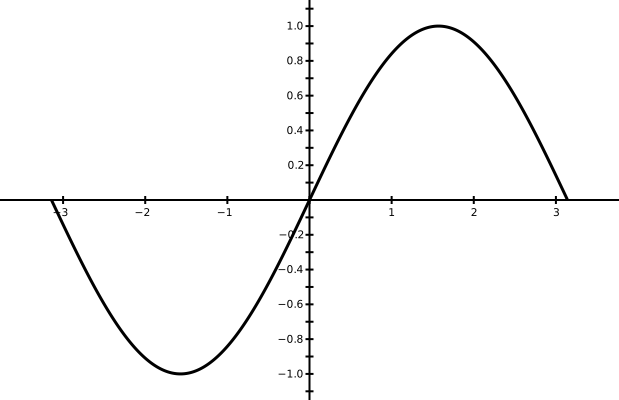
plot(y = sin(x), −π, π)
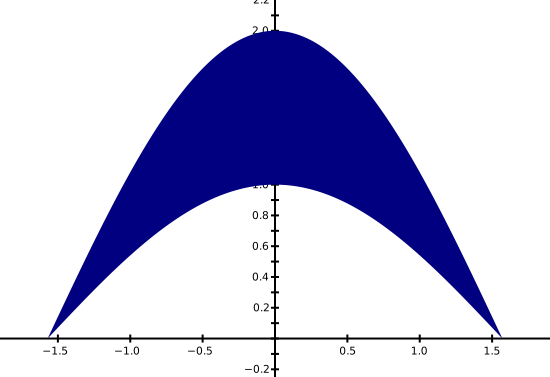
plot(cos(x) < y < 2⋅cos(x), −π, π)
plot([−2⋅π, 2⋅π] @ (t ↦ ❨5⋅cos(5⋅t)⋅sin(5⋅t), 5⋅sin(5⋅t)⋅sin(2⋅t), t❩))